Your home’s climate control system is arguably the most critical—and expensive—appliance you own. It dictates your daily comfort, safeguards your indoor air quality, and accounts for nearly half of your monthly energy expenditures. Yet, when a unit fails, many homeowners panic and hire the first available technician they can find on a quick web search. This hasty decision can lead to disastrous financial and structural consequences. The reality is that choosing a technician is just as important as choosing the equipment itself. Industry studies show that poor craftsmanship and improper setup can reduce a system’s efficiency by up to 30%, meaning even the most advanced, top-tier unit will perform like a budget model if installed incorrectly.
The modern indoor climate landscape has evolved dramatically over the past decade. We are no longer just dealing with simple thermostats and basic blowers. Today’s climate systems feature variable-speed compressors, intricate smart home technology integrations, and highly specific eco-friendly refrigerants. Furthermore, shifting weather patterns and increasingly extreme temperatures make expert, reliable service more critical than ever. A poorly maintained unit doesn’t just cost you comfort; it can lead to massive energy bills, repeated breakdowns, and a prematurely shortened equipment lifespan.
This guide provides a comprehensive roadmap of the ultimate vetting process to protect your home, your comfort, and your wallet. By following these rigorous steps, you will learn how to look past flashy marketing campaigns and objectively evaluate a service provider based on technical proficiency, business integrity, and long-term value.
Verify Licensing, Insurance, and Industry Certifications First

Check State Databases for Active Licenses and Workers’ Comp Insurance
The absolute baseline for any technician working on your property is proper licensing and comprehensive insurance. Do not take a company’s word for it when they claim to be licensed; you must take the extra step to verify this information independently. Every state has a licensing board or a department of labor website where you can look up the license numbers of HVAC contractors to ensure their credentials are active, valid, and free from severe disciplinary actions. This public record search will reveal if the company has a history of building code violations or unresolved consumer complaints.
Insurance is equally, if not more, important. A reputable company must carry two specific types of coverage: general liability insurance and workers’ compensation insurance. General liability protects your property; if a technician accidentally drops a heavy air handler through your ceiling or triggers a water leak that ruins your hardwood floors, their insurance covers the damages. Workers’ compensation protects you from liability. If an uninsured worker falls off your roof or injures themselves while carrying heavy equipment down your basement stairs, you—the homeowner—could be held financially and legally responsible for their medical bills and lost wages. Always ask for a Certificate of Insurance (COI) and do not hesitate to call the issuing agency to verify its current validity.
Look for NATE and ACCA Credentials on the Company Profile
Beyond mandatory state licenses, you should look for voluntary industry certifications that demonstrate a commitment to excellence and ongoing education. The most prominent of these is the North American Technician Excellence (NATE) certification. NATE is an independent, third-party non-profit organization that requires technicians to pass rigorous, knowledge-based exams covering complex diagnostics, electrical circuitry, and thermodynamics. When a company heavily employs NATE-certified technicians, it serves as the gold standard for skill and reliability.
Additionally, checking if an air conditioning contractor is a member of the Air Conditioning Contractors of America (ACCA) provides another layer of security. ACCA members are held to stringent national standards for indoor environmental systems. Members of these organizations have access to the latest technical manuals, safety protocols, and industry best practices.
Be wary of red flags during this phase. If a company uses vague terms on their website like “fully certified” but refuses to provide their license numbers on written estimates, marketing materials, or their website footer, consider it a massive warning sign and move on to the next candidate.
-
Actionable Checklist for Licensing and Insurance:
-
Locate the contractor’s license number on their website or ask for it directly.
-
Verify the license status via your state’s contractor board portal.
-
Request a physical or digital copy of the Certificate of Insurance (COI).
-
Ensure the COI clearly lists both General Liability and Workers’ Compensation.
-
Ask what percentage of their field technicians actively hold NATE certifications.
-
Look for 24/7 Availability and Quick Response Times

Test Their Customer Support Responsiveness Before a Crisis Hits
The true test of a service company’s operational excellence is not how they treat you when you want to buy a new unit, but how they respond when your equipment fails in the middle of a long holiday weekend. Before committing to a long-term service relationship, you should conduct a communication test. Call or message the company during off-hours or on a weekend. Pay close attention to whether your call is answered by a live, local dispatch service or if you are thrown into an endless loop of automated voicemails. A premium company understands that climate control emergencies do not adhere to standard business hours and will have a live answering service ready to triage your problem.
It is also vital to understand the difference between marketing guarantees and reality. Many companies advertise “priority service” or “same-day response,” but what do those Service Level Agreements (SLAs) actually dictate in writing? Often, priority service is reserved exclusively for customers who have signed up for their annual preventative maintenance programs. If you are a new customer calling for the first time during a severe heatwave, you may find yourself at the bottom of a very long waiting list.
Inquire About Specific Protocols for Off-Hour Failures
When interviewing a potential service provider, pose specific, hypothetical scenarios to gauge their readiness. Ask them exactly how their dispatch system handles extreme weather situations. For example, you need to know their protocol for executing emergency furnace repairs when the outside temperature plummets below zero and a delayed response could result in frozen and burst water pipes inside your walls. A well-organized company will have a clear triage system, prioritizing total system failures and households with vulnerable residents (like the elderly or infants) over routine maintenance calls.
You must also demand complete transparency regarding off-hour pricing. An unexpected HVAC repair during a holiday weekend is already stressful enough without being blindsided by exorbitant hidden costs.
-
Questions to ask regarding off-hour dispatch:
-
What is your standard diagnostic fee during normal business hours?
-
How much does that diagnostic fee increase on nights, weekends, and holidays?
-
Do you charge a flat “trip charge” just to drive to my home, regardless of the work performed?
-
Are your technicians paid purely on commission, or do they receive an hourly wage for after-hours calls? (Commission-only technicians may be heavily incentivized to upsell unnecessary parts during an emergency).
-
Demand a Manual J Load Calculation Before Buying a New Unit
Insist on a Physical Home Assessment Rather Than an Over-the-Phone Quote
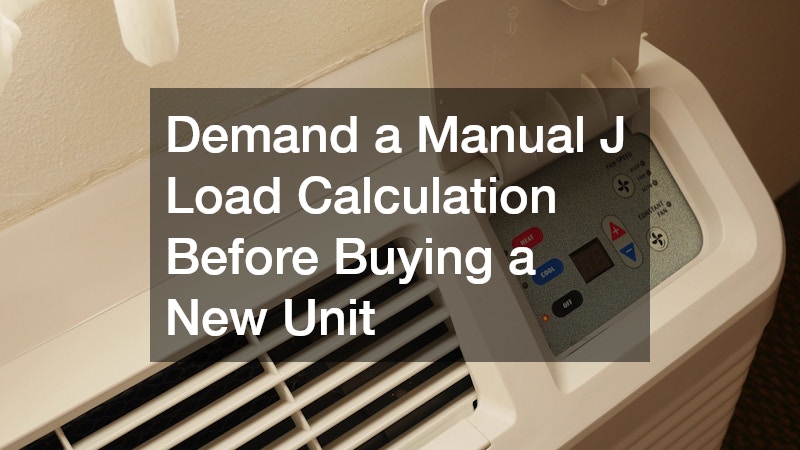
One of the most pervasive and damaging practices in the home services industry is providing over-the-phone estimates for full system replacements based solely on the square footage of a home. This outdated “rule of thumb” sizing is wildly inaccurate. A home’s cooling and heating demands are influenced by dozens of unique factors, not just floor space. If a company tries to sell you AC installation services without ever stepping foot inside your house to measure these variables, immediately disqualify them.
A true, professional evaluation requires a comprehensive mathematical assessment known as a Manual J Load Calculation. During this assessment, a top-tier specialist will spend significant time measuring and documenting your home. They will evaluate the depth and quality of your attic insulation, the R-value of your walls, the type and orientation of your windows (e.g., do you have massive, single-pane, south-facing windows that absorb massive amounts of solar heat?), the height of your ceilings, and the condition of your existing ductwork.
Why is this so crucial? If a unit is oversized, it will “short cycle”—turning on, blasting cold air, dropping the temperature rapidly, and shutting off before it has a chance to dehumidify the air. This results in a cold, clammy house, skyrocketing energy bills, and a worn-out compressor. Conversely, an undersized unit will run continuously without ever reaching the set temperature.
Compare Equipment Brand Options and Warranty Tiers
Homeowners should actively seek out AC installers who operate as independent dealers rather than being financially locked into pushing a single, proprietary brand. A company authorized to deal with multiple major manufacturers—such as Carrier, Trane, Lennox, or Goodman—can provide objective advice on which specific unit best fits your budget and specific climate needs.
Equally important is a deep dive into the warranty fine print. Do not assume that a “10-year warranty” covers everything. You must distinguish between the manufacturer’s warranty, which typically covers only the physical parts, and the company’s internal labor warranty.
-
Key points to verify on warranties:
-
Parts Warranty: Usually provided by the manufacturer (e.g., 5 to 10 years on the compressor and coils). This covers the cost of the replacement part itself if it suffers a factory defect.
-
Labor Warranty: Provided by the local company installing the unit (usually 1 to 2 years). This covers the hourly wages of the technician performing the replacement.
-
Warranty Registration: Ask who is responsible for registering the equipment with the manufacturer. If a unit is not registered within 60 days of installation, the 10-year warranty often defaults to a meager 5-year warranty.
-
Analyze Diagnostic Processes and Transparent Pricing Models

Request Itemized, Written Estimates for Component Replacements
A reputable company operates with complete financial transparency. When a technician finishes their evaluation, they should present you with an itemized, written estimate before a single wrench is turned. Never accept a verbal quote or a vague, hastily scribbled number on the back of a business card. A proper estimate will clearly break out the costs, allowing you to see exactly what you are paying for. It should separate the cost of the physical replacement parts, the projected labor hours, state and local taxes, necessary municipal permits, and any environmental disposal fees required for safely removing old refrigerants.
Understanding the technician’s diagnostic process is also essential. You want to ensure they aren’t just guessing at the problem. A standard AC repair visit should be meticulous. The technician should use advanced digital manifold gauges to check the precise refrigerant subcooling and superheat pressures. They should use a multimeter to check the electrical continuity, voltage, and amperage draws of the compressor and blower motor. They should also inspect the static pressure of the airflow to ensure there are no severe blockages in your ductwork. If a technician simply looks at your unit, listens to it for two minutes, and declares it dead, you are likely dealing with a salesperson, not a mechanic.
Evaluate the Tiered Options for Aging Cooling Units
As your equipment approaches the 10 to 15-year mark, you will inevitably face the difficult decision of whether to continue patching it up or invest in a brand-new system. A trustworthy company will not immediately pressure you into a high-pressure sales pitch for a new unit. Instead, they will help you evaluate your options objectively.
A helpful framework that honest technicians use to guide homeowners is the “5,000 rule.” To use this rule, simply multiply the age of your system by the estimated cost of the proposed repair. If the resulting number exceeds 5,000, it is generally more financially prudent to replace the unit rather than authorize complex, expensive AC system repairs. For example, if your unit is 12 years old and needs a $500 blower motor replacement ($12 \times 500 = 6,000), the math suggests a replacement is the smarter long-term investment.
-
Seek out companies that offer Good, Better, Best quoting systems:
-
Good: A basic, single-stage unit that meets minimum federal efficiency standards.
-
Better: A two-stage unit that offers improved humidity control and quieter operation.
-
Best: A variable-speed, ultra-high-efficiency system that provides premium comfort and the lowest possible energy bills.
-
Second Opinions: Always ask about their policy on second opinions. Many reputable companies offer free or deeply discounted second opinions if another company has condemned your system due to a major component failure, such as a cracked heat exchanger or a seized compressor.
-
Read Local Reviews and Assess Multi-Property Capabilities
Filter Online Reviews for Consistency and Geographic Proximity
In today’s digital age, online reviews are a powerful tool, but they can also be heavily manipulated. To get an accurate picture of a company’s reputation, you must learn how to filter and read reviews critically. Do not just look at the overall star rating on Google, Yelp, or Angi. Instead, read the actual text. Be highly skeptical of reviews that only feature a star rating with no text, or reviews that use overly generic praise like “Great job, highly recommend.”
You are looking for consistency and detailed storytelling. Authentic reviews often mention technicians by name, describe specific problems the homeowner faced, and detail exactly how the company resolved the issue. For example, a reliable indicator of quality is a review praising the technician for wearing shoe covers, cleaning up their work area before leaving, and taking the time to explain the thermostat settings.
Furthermore, hyper-local track records matter immensely. You want to find a team deeply experienced in local air conditioning repairs, as this ensures they have an intimate understanding of specific regional climate challenges. A company that operates heavily in a high-humidity coastal region will know exactly how to combat salt corrosion on condenser coils, while a company in a dry, dusty desert environment will have protocols for heavy-duty air filtration. Local companies also maintain strong relationships with municipal inspectors and are intimately familiar with local building codes, ensuring your permits are closed without a hitch.
Confirm Expertise in Complex, Multi-Zone, or Non-Residential Layouts
If you manage a large estate, an apartment building, or a business, the criteria for choosing a partner become significantly more stringent. You must identify if a service provider can scale up their capabilities to handle massive, complex layouts. Residential split systems are vastly different from the heavy-duty machinery used in non-residential applications.
You need to verify their specific experience in commercial HVAC services. Can they comfortably manage and maintain 20-ton Rooftop Units (RTUs)? Are their technicians trained to diagnose sophisticated Variable Refrigerant Flow (VRF) systems or massive cooling towers? Do they understand how to calibrate specialized make-up air units required for commercial kitchens or industrial manufacturing facilities?
-
Evaluating Long-Term Preventative Maintenance Agreements:
-
Whether you own a single-family home or a sprawling retail space, a company’s preventative maintenance agreement (PMA) is a great indicator of their long-term value.
-
Look for PMAs that include bi-annual visits (one in the spring for cooling, one in the fall for heating).
-
Ensure the agreement includes comprehensive coil cleanings, not just basic filter changes.
-
Verify if the agreement grants you priority emergency dispatch status and discounts on future replacement parts.
-
Conclusion: Making Your Final, Confident Decision
Selecting the right partner to maintain your home’s climate control system is a decision that requires patience, critical thinking, and a refusal to settle for vague promises. By adhering to the rigorous evaluation process outlined above, you safeguard yourself against opportunistic salespeople and unqualified handymen.
Remember the ultimate checklist: Never compromise on verifiable state licensing and comprehensive insurance. Insist on precise, mathematical load calculations rather than estimates based on guesswork. Demand itemized, transparent pricing before any work begins, and comb through local reviews to verify their community reputation and geographical expertise. A truly exceptional company will welcome these questions; they pride themselves on their transparency and technical superiority, and they will gladly provide you with the documentation you request.
Ultimately, trust your instincts during the initial consultation. Pay attention to their professionalism, their punctuality, and how much respect they show for your property. Do they take the time to answer your questions thoroughly, or do they rush you toward signing a contract?
Do not wait until you are shivering in the dead of winter or sweating through a summer heatwave to begin this search. The worst time to look for a reliable technician is during an active emergency. Take action now. Start researching local companies, ask the tough questions, and schedule a routine preventative maintenance inspection today. Establishing a relationship with a trusted professional before you desperately need them is the absolute best way to ensure your indoor environment remains safe, efficient, and perfectly comfortable year-round.